
Iran conflict
Market impacts. March 2026.
As you know, on 28 February 2026, the United States and Israel launched joint military strikes on Iran.
The main market impact for investors at this time is specifically whether a prolonged conflict further disrupts global oil supply, pushing energy prices higher, reducing global growth, impacting inflation, and ultimately weighing on asset class and investor returns.
Executive Summary
The markets are seeking to determine how long this conflict will last. The longer it lasts, the greater the impact to increased energy costs, inflation, and slowed growth.
However, while oil shocks typically cause initial negative market reactions, historical data over the past 35 years suggests US equities generally recover quickly, and completely within two years.
Portfolios have experienced minor fluctuations recently, although on par with "normal" volatility experienced in January this year. Beware of "availability bias" which is the tendancy to overly rely on current information rather representative or statistically meaningful information.
For our decumulators (those receiving regular withdrawals from the portfolio), a reminder that we hold up to two years known withdrawals in cash and cash equivalents, which have not been impacted.
In New Zealand, higher energy costs are expected to slow the near-term economic recovery by reducing consumer spending and business margins. While financial markets expect interest rate hikes, our economist believes the RBNZ may (and should) adopt a more cautious approach than the market predicts.
We maintain strongly diversified portfolios tailored to your investment horizon and long-term goals and we're always here if you need to chat.
Disruptions to the oil supply and what this means
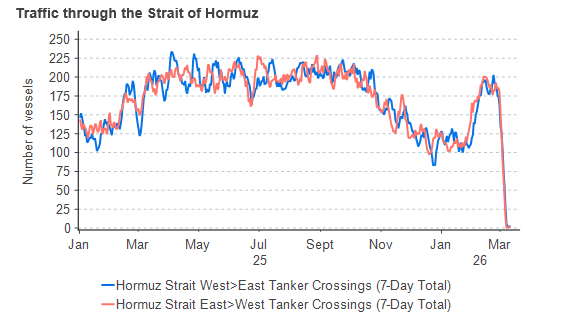
The most significant impact of this war from a markets perspective to date is the disruption to the oil supply. As you will likely have heard, 20% of all oil transits the Strait of Hormuz which has essentially halted.
Source: ANZ
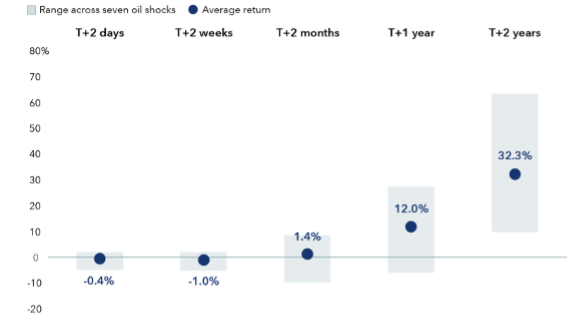
So, the markets are looking to the downstream impact from this. The initial market impact from an oil shock, naturally, is negative. However, if we look at the last seven oil shocks over the past 35 years, the US S&P 500 started to recover reasonably quickly, and within two years, in all cases returns were positive.
S&P 500 INDEX RETURNS FOLLOWING GEOPOLITICAL-RELATED OIL SUPPLY DISRUPTIONS, 1990-2024
Source: Capital Group
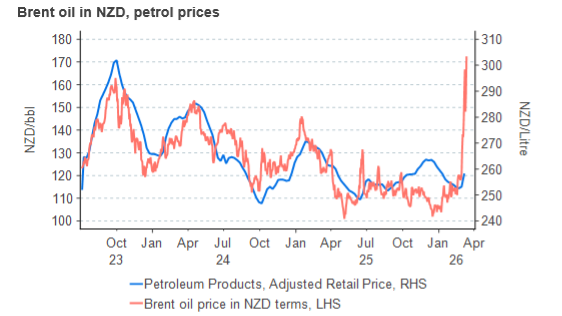
Closer to home, we are already feeling it at the pump (Pete was unable to fill up with 91 on Saturday because the petrol station was out!). You can see how our fuel prices directly correlate with the price of oil.
Source: ANZ
If we were to update this data to today, the blue line would be up aground the $3.00 mark (RHS shown as 300c), matching the red line.
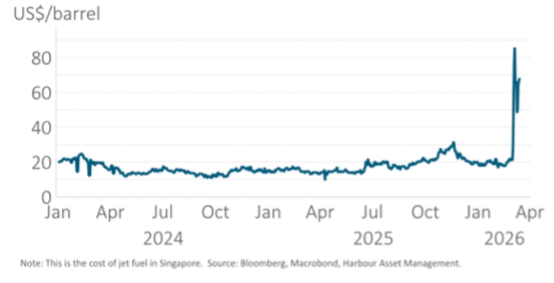
We’re also seeing airlines cut services, increase fares, and introduce fuel surcharges again. And here is why…
JET FUEL PREMIUM OVER BRENT CRUDE OIL
Equities and previous conflicts
While geopolitical shocks often feel like they will have big negative consequences for equites in the short-term, equities have historically shown time and time again to be mixed in the short-term (sometimes negative and sometimes positive) and both positive and a meaningful contributor to capital growth over the longer-term.
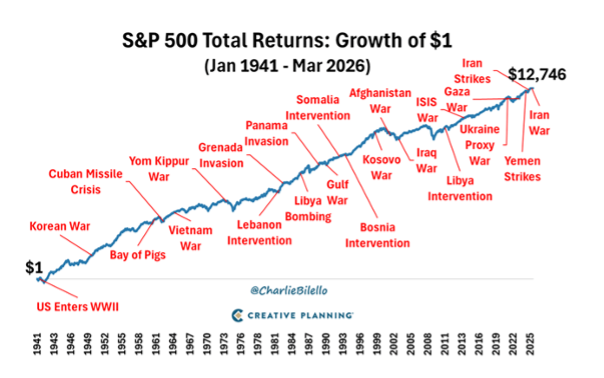
When Iraq invaded Kuwait in August 1990, the reaction was swift and alarming. Oil prices surged more than 30% within days. The S&P 500 fell more than 10% in the weeks that followed. Headlines warned of war, energy shortages, and global recession. It felt, to many investors at the time, like the world was coming apart.
Here is what actually happened to US equities over the following time periods:
1 year after the invasion began: +12.8%
2 years later: +27.2%
3 years later: +38.3%
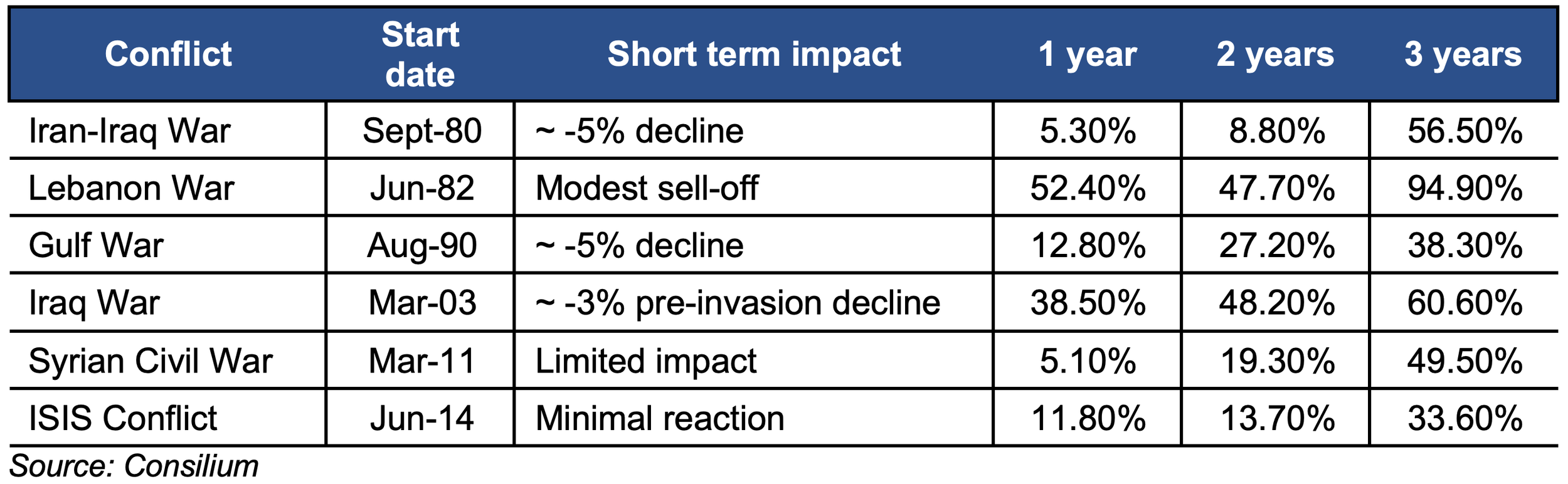
The Gulf War was not unique. Here’s the impact on the S&P 500 from the past six Middle East conflicts.
Broader asset class impacts
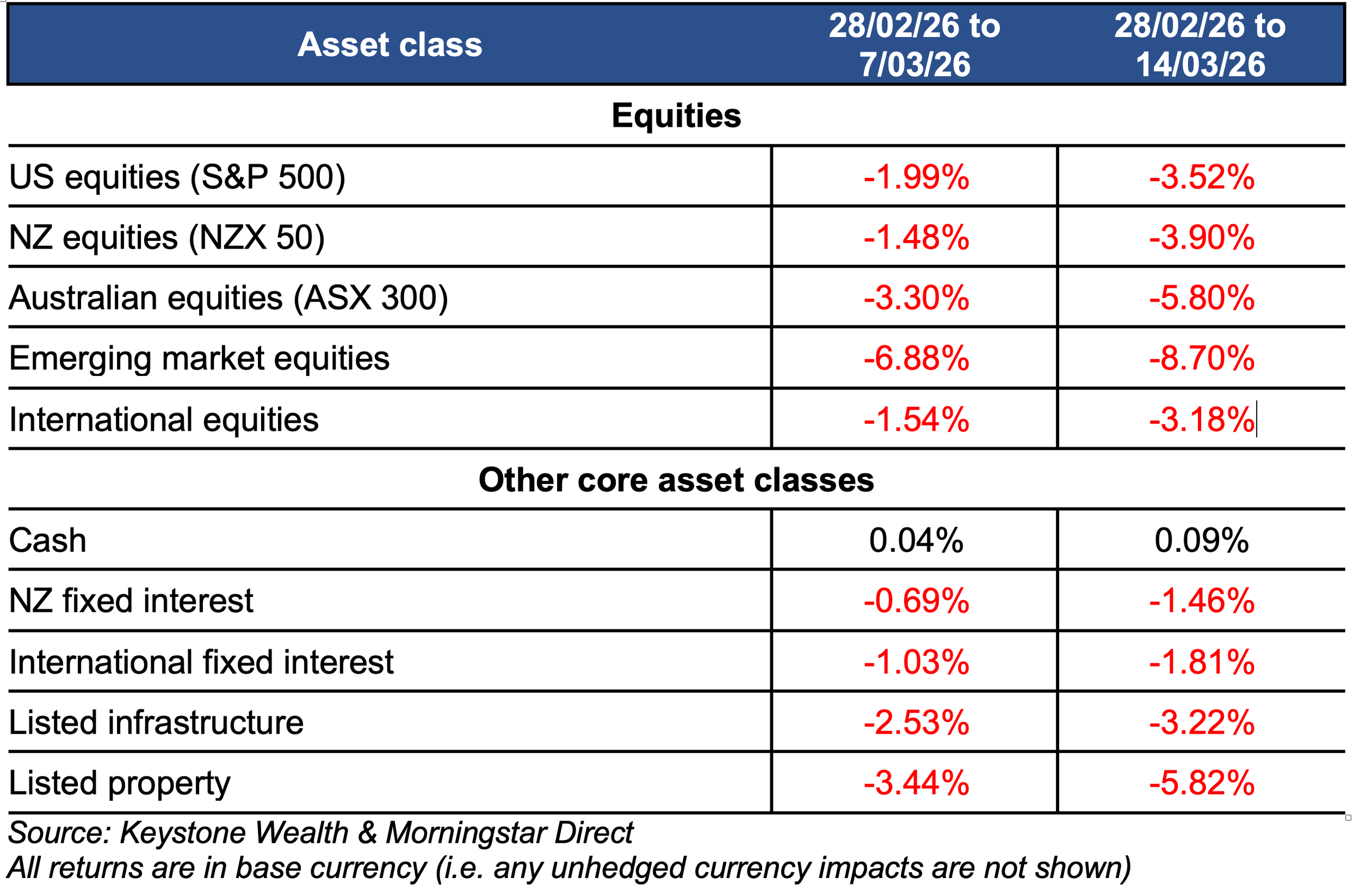
This is how key markets and core asset classes have moved since this war began.
What this means for your portfolio
The impact on Keystone Wealth Core Portfolios (Low Growth, Balanced Growth, Growth, and High Growth) over the same periods ranges from:
-1.10% to -1.70% for 28/02/26 to 7/03/26; and
1.50% to -2.30% for 28/02/26 to 14/03/26.
This highlights the importance of diversification, including beyond the core asset classes.
Beware the noise
Sometimes context can also be important. Did you know that your core portfolio may have suffered a larger fall in January? From 15/01/2026 to 01/02/2026, the Keystone Wealth Core Portfolios were down between -0.80% and -2.40%.
We note this conflict and the corresponding market reaction(s) is not yet complete and that no one knows just how much markets may ultimately decline this time around. However, we highlight this comparison to demonstrate some behavioural biases commonly found in investors, including:
Availability Bias – The tendency to rely on information that comes to mind quickly, rather than information that is actually representative or statistically meaningful when considering our investments (usually because it’s vivid, recent, or widely discussed). Despite similar drawdowns at this point in time, we had no enquiries or concerned emails, texts or phone calls about the market movement back in January.
We’ve got you covered
A reminder that we hold up to two years known withdrawals for our decumulating clients in a cash sub-strategy, which further limits any short-term volatility impact on funds required, no matter how the following months unfold.
If you think you may have some additional upcoming expenses over the next couple of years, let us know and we will look to make sure we are holding sufficient funds in your cash sub-strategy.
And what about the impact on the NZ economy
Before the conflict escalated, there was a reasonable consensus that the New Zealand economy was on a recovery path. Terms of trade had been strong, rural incomes were holding up, and the capital account had performed better than expected. However, fourth quarter 2025 growth data disappointed, and much of the positive narrative had been resting on the stronger third quarter figures. The first quarter of 2026 needed to deliver to sustain that story.
Whilst only time will tell, our economist Andrew Hunt's assessment is that the oil shock is likely to derail that recovery narrative, at least in the near-term. Higher energy costs are ultimately a tax on the consumer which will put pressure on household spending and business margins.
On the interest rate front, markets have moved quickly to price in more rate hikes sooner and the NZ 10-year bond yield is up 0.42% over the month to date to move to 4.75%, the highest since the Tariff Tantrum last year.
During the 1990 Gulf War, the RBNZ was compelled to raise rates as inflation rose, even as the economy weakened, and then had to reverse course with aggressive cuts shortly after. Our economist Andrew Hunt believes the RBNZ should go on hold this time around while the picture becomes clearer, and then likely raise rates, but probably by less than financial markets are currently pricing in. Most market participants we follow also seem to think this is the most likely course of action.
Regardless, the RBNZ finds themselves once again in the hot seat as they must balance the likely impacts on headline CPI inflation of rising energy prices with the potentially negative future impacts to growth and their goal of achieving maximum sustainable employment.
So, where to from here?
We are not in the forecasting business, but we can talk to what we’re hearing from our managers and research partners.
The key question is not how bad the situation looks today, but how long it lasts. This along with how governments, central banks and ultimately investors (or more broadly people) react will determine the outcomes for various asset classes.
The longer this conflict lasts, the greater the likely impact on markets. That said, several of our managers have noted that “with US midterm elections on the horizon, American voters have consistently shown they oppose prolonged military engagement, and they are particularly sensitive to rising petrol prices. This creates a natural ceiling on how far the US is likely to escalate”.
We maintain strongly diversified portfolios that we believe are well placed to achieve investor outcomes over their investment horizon. We tailor your specific portfolio (including managing a cash sub-strategy for those with known withdrawals) to enable your core sub-strategy to remain focused on your long-term goals.
As always, if you have any questions or would like to discuss your circumstances, please let us know.